
The Guanches: The Aboriginal People of the Canary Islands
Who were the Guanches?
The Guanches were the aboriginal people of the Canary Islands, living here for around two thousand years before the Spanish conquest of the 15th century. Strictly, the name refers to the original inhabitants of Tenerife, but it is commonly used for the aboriginal peoples of all the islands. They were of North African Berber (Amazigh) origin, and by the time Europeans arrived they were living a Stone Age way of life, herding goats and living in caves.
This is a short guide to who they were, how they lived, how their world ended, and where you can still see their heritage in Tenerife.
Where they came from
Genetic and linguistic evidence links the Guanches to the Berber peoples of North Africa. They are thought to have reached the islands during the first millennium BCE, though exact dates and the means of arrival are still debated. Once on the islands they were effectively cut off: by the time of European contact they had no boats and no knowledge of seafaring, which is part of why each island developed its own distinct culture.
They had no metalworking and no writing in the usual sense, though rock carvings and inscriptions survive at several sites.
How they lived
The Guanches lived mainly in natural caves and simple stone shelters. They herded goats, sheep and pigs, and grew barley and wheat, which they roasted and ground into a flour called gofio. Gofio is still a staple of Canarian cooking today, which makes it one of the most direct links between modern Tenerife and its aboriginal past.
They made pottery by hand, without a wheel, and tools from stone, bone and wood. Clothing was made from goat hides.
The menceyes and society
At the time of the conquest, Tenerife was divided into nine small kingdoms called menceyatos, each ruled by a king known as a mencey. The other islands had their own leaders and structures. This division into rival kingdoms shaped how the conquest played out, since the Castilians could ally with some menceyes against others.
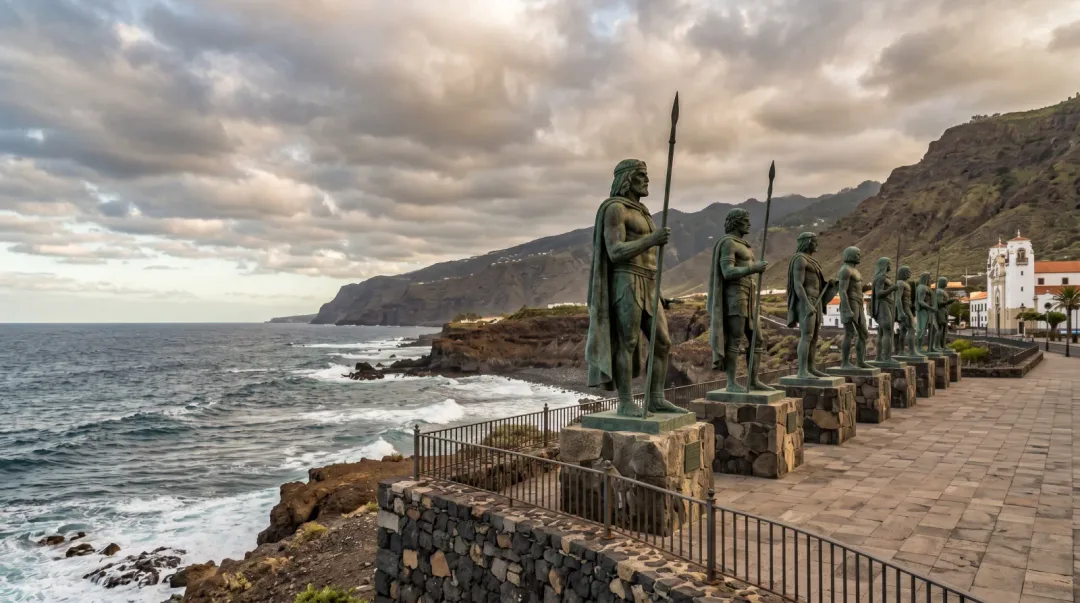
The nine menceyes of Tenerife are commemorated today by a row of large bronze statues on the seafront at Candelaria.
Mummification
The Guanches mummified their dead. Bodies were treated, wrapped in goat skins and laid in burial caves, sometimes in large numbers. A number of these mummies survive and are now held in the Museo de la Naturaleza y Arqueología in Santa Cruz de Tenerife, which has the main collection of Guanche remains and artefacts.
The dragon tree (Dracaena draco) was significant to them, and its red resin, known as dragon's blood, was used in rituals and as a medicine. You can read more about that in our guide to the Drago Milenario of Icod de los Vinos.
The conquest
The Castilian conquest of the Canary Islands took most of the 15th century, island by island. Tenerife was the last to fall. In 1494 the menceyes inflicted a heavy defeat on the Castilian forces at the first battle of Acentejo, near what is now La Matanza ("the slaughter"). The Castilians regrouped and won the following year, and the conquest of Tenerife was completed in 1496.
After the conquest, disease, slavery and assimilation reduced the Guanche population quickly. They did not vanish entirely: their genes, place names and some customs carried on into the mixed population that followed.
Guanche heritage you can still see in Tenerife
- The Museo de la Naturaleza y Arqueología (MUNA) in Santa Cruz: the main museum collection, including Guanche mummies, pottery and tools.
- The Candelaria statues: the nine bronze menceyes on the seafront, next to the Basílica de Candelaria.
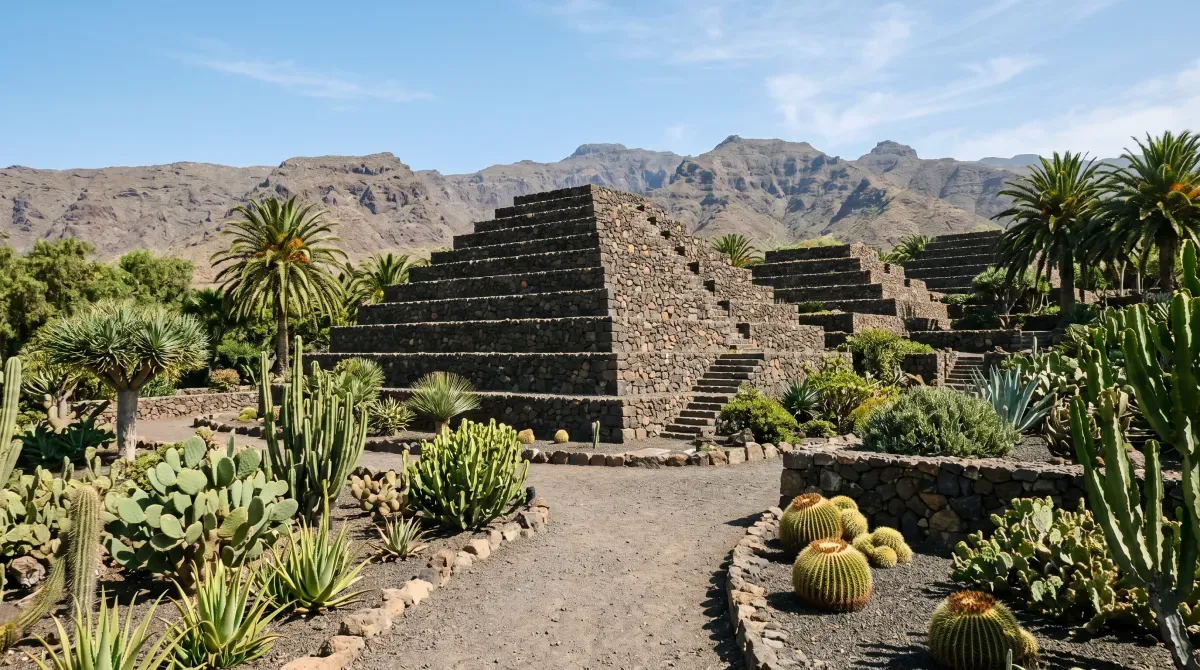
- The Pyramids of Güímar: stepped stone terraces whose origin is debated; the on-site park presents the theories. Worth a visit if the subject interests you.
- Rock carvings and cave sites across the island, some accessible, many protected.
For more on the island's layered history, see our guides to historic Tenerife and the old town of La Laguna.
Guanche questions
Who were the Guanches? The aboriginal people of the Canary Islands, of North African Berber origin, who lived on the islands for around two thousand years before the Spanish conquest of the 15th century.
Where did the Guanches come from? From the Berber peoples of North Africa, reaching the islands during the first millennium BCE. Genetic and linguistic studies support the North African link.
Do the Guanches still exist? Not as a separate people. The conquest, disease and assimilation ended their distinct society, but their ancestry, place names and some traditions (such as gofio) live on in modern Canarian culture.
Where can I see Guanche history in Tenerife? The Museo de la Naturaleza y Arqueología in Santa Cruz holds the main collection. The Candelaria statues and the Pyramids of Güímar are other places linked to the aboriginal past.