The Millennium Dragon Tree of Icod de los Vinos: Discover the Legend
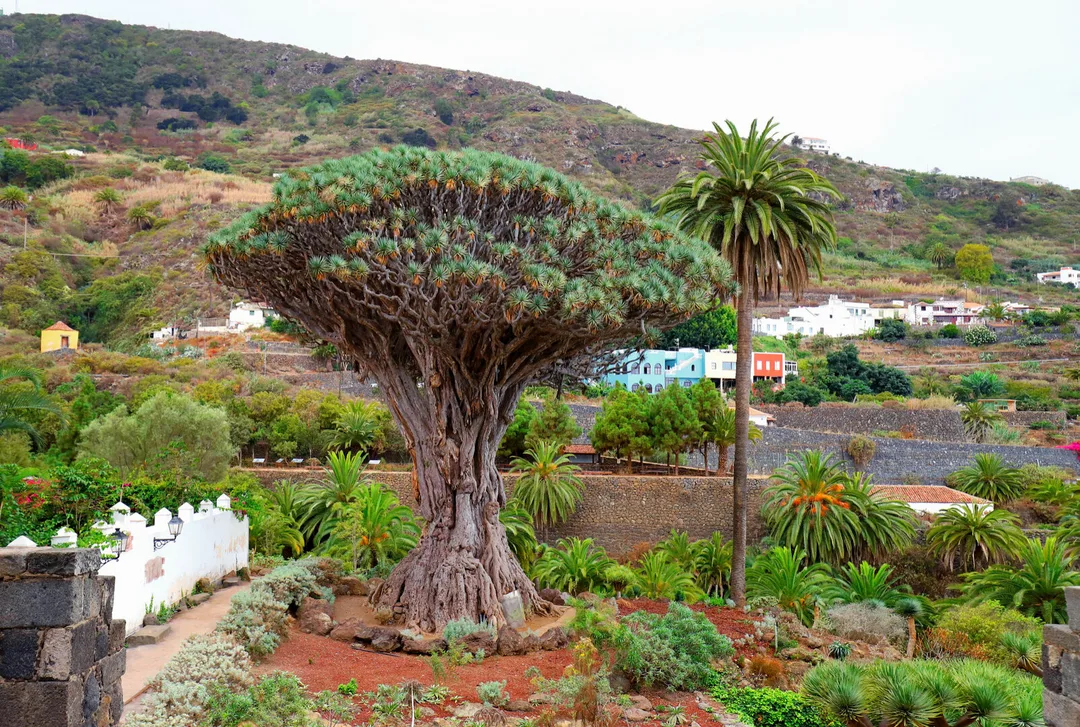
The Drago Milenario of Icod de los Vinos: Tenerife's ancient dragon tree
The Drago Milenario in Icod de los Vinos is the largest and oldest living dragon tree (Dracaena draco) in the world. It's one of the symbols of Tenerife, declared a national monument in 1917, and one of the most visited natural attractions on the island. If you've seen Tenerife on a stamp or a coat of arms, you've probably seen this tree.
This guide covers what the Drago Milenario actually is, how old it really is (the answer is more interesting than the marketing), how to visit Parque del Drago in Icod de los Vinos, and what else is worth seeing in the area.
What is the Drago Milenario?
The Drago Milenario is a Dracaena draco (Canary Islands dragon tree). It stands 20 to 21 metres tall (66 to 69 feet), has a trunk circumference of around 20 metres at the base, more than 300 main branches, and weighs an estimated 140 tonnes. The trunk contains a 6-metre-high cavity that's accessible through a door, with a fan installed inside to provide ventilation.
When the tree flowered in 1995, it had around 1,800 flowering branches and gained 3.5 tonnes of weight during the fruiting season. That gives you an idea of the scale.
The dragon tree species (Dracaena draco) is native to the Canary Islands, Madeira, Cape Verde, and parts of western Morocco. The Drago Milenario in Icod is the most famous individual specimen in existence and the largest known.
How old is the Drago Milenario actually?
This is where it gets interesting. The tree is marketed as "thousand-year-old" (the name "Milenario" literally means millennium-old), and most tourist sources say 800 to 1,000 years.
The honest answer is: the age is disputed. Dragon trees don't have annual growth rings like normal trees, which makes dating extremely difficult. Different scientific estimates have reached wildly different conclusions:
In 1907, professors at the Polytechnic School of Zurich estimated a similar tree on Tenerife at 2,500 years old. Alexander von Humboldt thought another dragon tree on the island (which fell in a storm in 1867) was several thousand years old. But in 1975, a German botanist named Magdefrau put an upper limit of 350 years on the Drago Milenario based on growth rate analysis. More recent studies suggest around 800 to 1,000 years.
The official position used by the Icod town council is 800 years. So the real answer is: somewhere between 350 and 1,000+ years old, with 800 being the most commonly cited figure. Either way, it's old enough to be impressive.
Where the dragon tree's name comes from
The dragon tree gets its name from its red resin, called "dragon's blood" (sangre de drago). When the bark or branches are cut, the tree releases a viscous, deep red sap that hardens. Historically this resin was prized for its medicinal properties (it was used as an antiseptic and wound treatment), as a varnish, and as a dye.
The Guanches, the original inhabitants of the Canary Islands before Spanish colonisation, used dragon's blood resin in their burial rituals and for medicinal purposes. The trees were considered sacred. After the Spanish conquest, the resin became a valuable export to mainland Europe.
The mythological version of the story is more dramatic: the tree supposedly grew from the spilled blood of a dragon killed by Hercules during one of his labours (the eleventh, where he had to steal golden apples from the Garden of the Hesperides, which Greek geographers identified with the Canary Islands).
Visiting Parque del Drago in Icod de los Vinos
The Drago Milenario is located in Parque del Drago, a 3-hectare botanical garden in the centre of Icod de los Vinos. The park was created around the tree at the turn of the millennium and contains a collection of native Canarian plants including younger Dracaena draco specimens, cardones, tabaibas, and other endemic species.
Beyond the dragon tree itself, the park includes a winery building, a coal bunker, and a cave with a recreation of a Guanche burial. There are walking paths, signage, and viewpoints. You can spend 45 minutes to an hour exploring everything, depending on your pace.
Parque del Drago opening times: Daily, generally 10am to 6pm (October to March). Hours may extend in summer. Open year-round.
Parque del Drago entrance fee (2026):
- Adults: €5
- Students and pensioners: €3
- Children under 8: €2.50
- Icod de los Vinos residents: free
Important honest tip: You can see the Drago Milenario for free from the church square (Plaza de la Iglesia) right next to the park. Many visitors are happy with this view alone and skip the entrance fee. The paid entry gives you closer access, the botanical garden, and the cave with the Guanche burial recreation. Whether the €5 is worth it depends on how much you want to see.
Address: Parque del Drago, next to the Iglesia de San Marcos, Icod de los Vinos.
How to get to the Drago Milenario
By car: Icod de los Vinos is on the north coast of Tenerife, about 45 minutes from Santa Cruz, 20 minutes from Puerto de la Cruz, and 1 hour from the south coast resorts (Costa Adeje, Playa de las Americas, Los Cristianos) via the TF-1 and TF-5 motorways. Parking is available in the town centre, including a paid car park near Parque del Drago.
By bus: TITSA bus lines 363 and 354 serve Icod de los Vinos. Check the latest TITSA timetables before your trip.
On a guided tour: Many north Tenerife guided bus tours include Icod de los Vinos and the Drago Milenario as a standard stop, along with Garachico and La Orotava. Hotel pickup from south Tenerife included. This is the easiest option if you don't want to drive yourself.
What else to see in Icod de los Vinos
Don't just visit the dragon tree and leave. Icod de los Vinos is a pleasant traditional town worth exploring for an hour or two beyond the Parque del Drago.
Iglesia de San Marcos. The 16th-century church next to Parque del Drago. Has a notable silver Mexican-style cross inside. Free entry.
Plaza de la Iglesia. The town square right next to the dragon tree, with the best free view of the Drago Milenario from outside the park.
Mariposario del Drago. A butterfly garden right next to Parque del Drago. Worth visiting if you're already there with kids.
Cueva del Viento. One of the longest volcanic tube cave systems in Europe (around 18 km of mapped passages, of which a small section is open to visitors). Located on the outskirts of Icod. Visits are guided and require booking in advance. A genuine highlight if you're interested in geology.
The town centre. Cobbled streets, traditional Canarian architecture, small shops, and several wine bars. Icod de los Vinos translates to "Icod of the Wines" and has historically been a wine-producing area. Several local bodegas produce wines from the volcanic soil of the surrounding hills.
The other dragon trees of Tenerife
The Drago Milenario isn't the only Dracaena draco on the island. You'll find younger dragon trees in:
Parque del Drago itself (smaller specimens in the botanical garden alongside the famous one).
El Drago de Pino Santo in Tacoronte, another notable old specimen.
The mountains of Anaga and Teno, where wild dragon trees still grow in some hard-to-reach spots.
Many private gardens across the island. They're a slow-growing tree but they're cultivated as ornamentals.
The Drago Milenario in Icod is the biggest and most famous, but the species itself is more widespread than most visitors realise.
Tips for visiting the Drago Milenario
Combine with other northern stops. Icod is on the north coast and works well as part of a day trip that includes Garachico (10 minutes west, with the famous natural lava pools), Puerto de la Cruz (15 minutes east), and La Orotava (25 minutes east). You can hit all of these in a single day from the south coast.
Allow 1 to 2 hours. If you're paying entry to Parque del Drago, plan for about an hour. If you're just viewing from the church square, 15 to 20 minutes is enough.
Wear comfortable shoes. The park paths are mostly fine but the wider Icod town centre has cobbled streets and slopes.
Don't expect to touch the tree. It's protected and fenced off. You can get close enough for photos but not actually reach it.
Visit in the morning. Cooler, quieter, and better light for photos. Tour buses tend to arrive late morning to early afternoon.
Explore north Tenerife with CanaryVIP
North Tenerife guided bus tours from CanaryVIP include Icod de los Vinos and the Drago Milenario, along with Garachico, La Orotava, and other northern highlights. Hotel pickup from south Tenerife included. Jeep tours reach more remote areas of the north.