
The history of Tenerife: from the Guanches to the present day
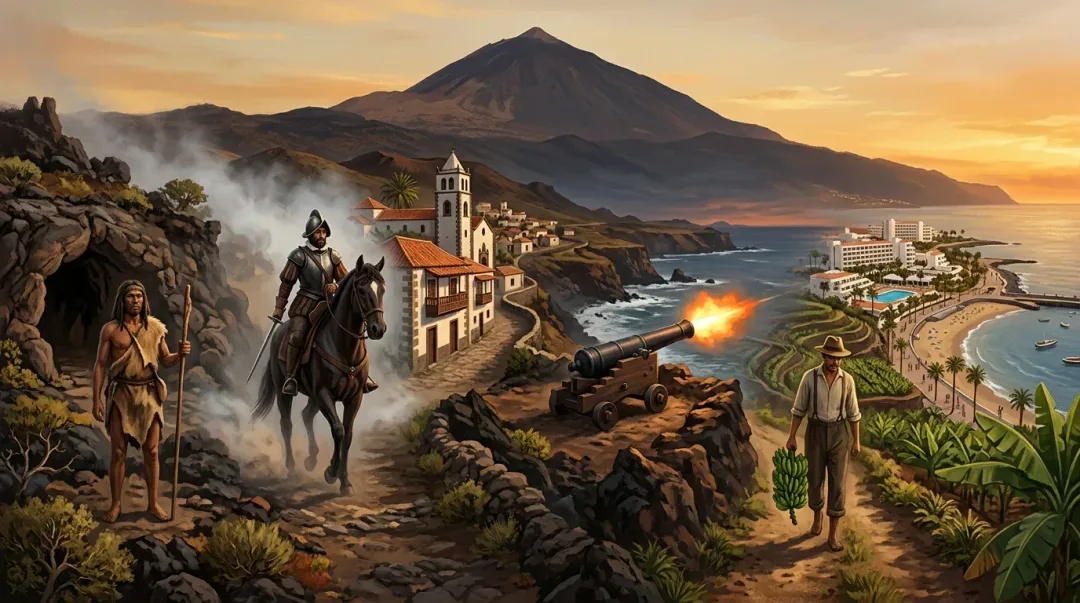
A 2,000-year story in seven chapters
Tenerife has a history that goes back more than two thousand years before the first tourist stepped off a plane. The island was home to an indigenous people who lived in isolation for over a millennium, fought one of the fiercest resistance campaigns against Spanish conquest in the 15th century, and later became a key stop on Atlantic trade routes to the Americas. Even Horatio Nelson lost his right arm trying to invade Santa Cruz.
This guide covers the real history of Tenerife in chronological order: the Guanches, the Spanish conquest, the colonial period, pirate attacks, Nelson's failed invasion, and the development of tourism in the 20th century. No mythology, no vague "rich tapestry of culture", just what actually happened and where you can still see the evidence today.
The Guanches: Tenerife's original inhabitants
The Guanches were the indigenous people of Tenerife. The term originally referred only to the inhabitants of Tenerife, though it's now commonly used for the aboriginal populations of all seven Canary Islands.
Where they came from. The Guanches were of Amazigh (Berber) origin, from North Africa. Their language (now extinct, but fragments survive in place names and historical records) shows clear similarities to Berber languages. Genetic studies confirm North African ancestry, with modern Canary Islanders still carrying 16 to 31% Guanche autosomal DNA depending on the island.
When they arrived. The dating is debated. Archaeological evidence from the Cave of the Guanches in Icod de los Vinos suggests habitation from the 6th century BC based on pottery analysis. Ancient DNA studies have found genomes dating to around 1031 BC. The most common estimate is that they arrived in stages during the first millennium BC. How they made the crossing from North Africa (roughly 100 km) without leaving any evidence of boats or navigation knowledge remains one of the great mysteries of Canary Islands archaeology.
How they lived. The Guanches lived primarily in natural caves and volcanic tubes, though some surface settlements with drystone structures have been found. Their economy was based on goat and sheep herding, basic agriculture (barley, wheat, beans), and limited fishing. They made gofio (a toasted grain flour still eaten in the Canary Islands today) and produced pottery, bone tools, and clothing from goat skins.
How their society was organised. When the Spanish arrived in 1494, an estimated 15,000 to 30,000 Guanches lived on Tenerife, divided into nine menceyatos (kingdoms): Anaga, Tegueste, Tacoronte, Taoro, Icod, Daute, Adeje, Abona, and Guimar. Each was ruled by a mencey (roughly equivalent to a king). The nine divisions correspond roughly to areas of modern Tenerife that still bear these names.
Religion and burial. The Guanches worshipped Magec (the sun god) and Chaxiraxi (a mother goddess later syncretised with the Virgin of Candelaria, the patron saint of the Canary Islands). Mount Teide was believed to be the dwelling place of Guayota, an evil spirit. They practised mummification, with techniques that researchers have compared to those of ancient Egypt. Over 200 Guanche mummies have been found on Tenerife, the richest concentration in the Barranco de Herques.
The Spanish conquest (1494 to 1496)
The Spanish conquest of the Canary Islands began in 1402, but Tenerife held out longer than any other island. The first serious attempt to conquer Tenerife came in 1464, more than 30 years before it finally fell.
In 1494, Alonso Fernandez de Lugo (whose name you'll see on street signs across the island) landed on the coast near present-day Santa Cruz with a force of over 1,000 men, including Castilian soldiers, Canarians from already-conquered islands, and a cavalry unit. Four of the nine Guanche menceys (Guimar, Adeje, Abona, and Anaga) negotiated peace treaties with the invaders. The other five refused to submit.
The First Battle of Acentejo (31 May 1494). As de Lugo's forces advanced into the interior towards Taoro (modern Puerto de la Cruz and La Orotava), they were ambushed in a ravine by Guanche warriors led by Mencey Bencomo and his half-brother Tinguaro. The Spanish were devastated, losing around 80% of their force. De Lugo himself was wounded and barely escaped. The modern town of La Matanza de Acentejo ("The Slaughter of Acentejo") marks the site of this battle.
De Lugo's return (1495). After selling his properties to fund a new campaign, de Lugo returned with 1,000 veterans of the Granada War plus cavalry. In November 1495, the Guanches were defeated at the Battle of Aguere (near modern La Laguna). Bencomo was killed.
The Second Battle of Acentejo (25 December 1495). The Guanches, now led by Bencomo's son Bentor and weakened by an epidemic (likely smallpox brought by the Spanish), were defeated near the same site as their earlier victory. After three hours of fighting, the Spanish firearms and cavalry overwhelmed them. The modern town of La Victoria de Acentejo ("The Victory of Acentejo") marks this site.
The conquest formally ended on 25 July 1496 with the Treaty of Los Realejos in the Orotava Valley. Bentor is said to have thrown himself off a cliff rather than submit to Spanish rule. Many Guanches were enslaved despite a papal ban on the slave trade with Canary Islanders dating to 1434. In 1511, an order was issued to release all Guanche prisoners.
Within a few generations, the Guanche language, culture, and identity were largely absorbed into the colonial Spanish population. But their genetic legacy persists: modern Tinerfeños carry significant indigenous ancestry.
Colonial Tenerife (16th to 18th century)
After the conquest, Tenerife was reshaped rapidly. San Cristobal de La Laguna became the first capital and was laid out using a grid plan that later became the model for Spanish colonial cities in the Americas. La Laguna's historic centre is now a UNESCO World Heritage Site partly for this reason.
Agriculture and trade. The Spanish cleared large areas of native pine forest and planted sugar cane. When sugar prices collapsed, the economy shifted to wine (especially sweet Malvasia, which became famous across Europe and was mentioned by Shakespeare). Later came cochineal (a red dye produced from insects), tobacco, tomatoes, and eventually bananas, which remain a major crop today.
Atlantic trade routes. Tenerife's position between Europe, Africa, and the Americas made it a vital stopping point. Christopher Columbus stopped at neighbouring La Gomera in 1492 on his first voyage to the Americas. Magellan chose Tenerife for his stopover in 1519 when he set out to circumnavigate the globe. Santa Cruz became a major port connecting Spain with its American colonies.
Pirate attacks. This strategic importance attracted unwanted attention. Pirate flotillas patrolled the waters between the Azores and the Canary Islands from the 16th century onwards, attacking ships and raiding coastal settlements. In April 1657, English Admiral Robert Blake attacked and destroyed a Spanish treasure fleet at Santa Cruz.
Mass emigration to the Americas. From the 17th century onwards, large numbers of Canarios emigrated to Spanish colonies, particularly Venezuela, Cuba, and Puerto Rico. This connection is still visible today in shared surnames, food traditions, and the distinctive Canarian Spanish accent, which sounds closer to Caribbean Spanish than to mainland Castilian.
Nelson's failed invasion (1797)
On 25 July 1797, British Rear-Admiral Horatio Nelson attempted to capture Santa Cruz de Tenerife with a force of around 900 men, hoping to seize a Spanish treasure ship and gain a strategic base in the Atlantic. The attack failed badly.
Spanish forces under General Antonio Gutierrez were prepared. The narrow streets of Santa Cruz favoured the defenders, and the British landing parties were met with heavy artillery and musket fire. Nelson personally led one of the landing parties but was struck in the right arm by grapeshot as he tried to disembark. His arm had to be amputated that night.
The British were forced to retreat with significant casualties. In a famous gesture of chivalry, General Gutierrez sent wine and bread to the defeated British forces before they left. Nelson's cannon, El Tigre (the cannon believed to have fired the shot that wounded him), is still displayed in Santa Cruz.
This was one of the few defeats in Nelson's career and remains a point of local pride in Santa Cruz. The event was also a turning point for Nelson, who went on to win the Battle of the Nile and Trafalgar with only one arm.
19th and 20th century: from agriculture to tourism
In 1821, Santa Cruz became the first capital of the entire Canary Islands province. This displeased Las Palmas (Gran Canaria), and after over a century of rivalry, Madrid split the archipelago into two provinces in 1927: Santa Cruz de Tenerife (covering Tenerife, La Gomera, La Palma, and El Hierro) and Las Palmas de Gran Canaria (covering Gran Canaria, Lanzarote, and Fuerteventura). This division persists today, with the two capitals alternating as seat of the Canary Islands government.
The banana economy. The late 19th century saw the rise of banana cultivation, which transformed Tenerife's agricultural landscape. British trading companies established banana export businesses, and the distinctive small Canarian banana (different from the larger varieties grown in Central America) became the island's primary export crop. Banana plantations still cover much of the north coast.
Early tourism. Tenerife began attracting visitors in the late 19th century, initially wealthy northern Europeans drawn by the mild climate for health reasons. Puerto de la Cruz became the first resort area.
Mass tourism. The real transformation came in the 1960s with the development of Reina Sofia Airport in the south and the construction of large resort hotels along the coast of Playa de las Americas and Los Cristianos. Within two decades, tourism replaced agriculture as the island's primary economic activity. Today, Tenerife receives around 6 million visitors per year, making it the most visited Canary Island.
Tenerife today
Tenerife is an autonomous community of Spain with its own island government (Cabildo). The population is around 950,000 people, making it the most populated island in the Canary Islands and the most populated island in Spain. The capital is Santa Cruz de Tenerife.
Spanish is the official language. The Canarian accent and vocabulary are distinct from mainland Spanish, influenced by Portuguese, the Guanche language, and Latin American Spanish (due to centuries of emigration and return).
The economy is overwhelmingly based on tourism, with services making up around 75% of GDP. Agriculture (bananas, tomatoes, potatoes, wine) and construction make up most of the rest. The island is part of the EU but has a special economic zone with lower taxes than mainland Spain (IGIC instead of IVA, currently at 7%).
The Guanche heritage is still visible in place names (Tacoronte, Tegueste, Adeje, Guimar, Icod, Anaga), in gofio (still eaten daily by many Canarians), in lucha canaria (Canarian wrestling, a traditional sport), and in the continued reverence for the Virgen de Candelaria, the patron saint of the Canary Islands, whose origins trace back to the Guanche goddess Chaxiraxi.
Where to see Tenerife's history
Museo de Naturaleza y Arqueologia (MUNA). In Santa Cruz. The main archaeological museum in Tenerife. Houses Guanche mummies, tools, pottery, and extensive exhibits on pre-Hispanic Canary Islands culture.
La Laguna historic centre. UNESCO World Heritage Site. The grid layout that became the model for Spanish colonial cities. See our La Laguna guide.
Piramides de Guimar. Six step pyramids in Guimar, with a museum exploring their possible connections to pre-Hispanic cultures. The site was researched by Norwegian explorer Thor Heyerdahl.
Castillo de San Cristobal. The remains of the fortress in Santa Cruz where the Spanish defended against Nelson's attack. El Tigre cannon is on display nearby.
Cueva de los Guanches. In Icod de los Vinos, one of the oldest archaeological sites on the island, with evidence of habitation from the 6th century BC.
La Matanza and La Victoria de Acentejo. Two towns whose names literally record the two battles of the Spanish conquest: "The Slaughter" and "The Victory".
Explore Tenerife with CanaryVIP
To see the historical north of Tenerife (La Laguna, La Orotava, Icod de los Vinos, Garachico), CanaryVIP's guided bus tours include these stops with hotel pickup from the south. For the volcanic landscapes that shaped the island's history, see the Teide guided tour.
Related experiences
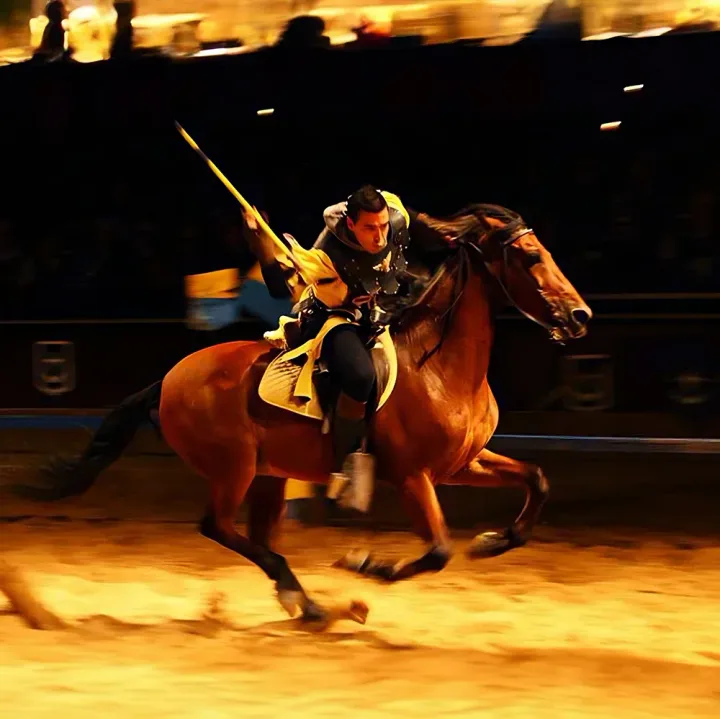 Shows
Shows Castillo San Miguel Tenerife
- Live medieval show
- Dinner included
- Shows Tue, Thu & Sat
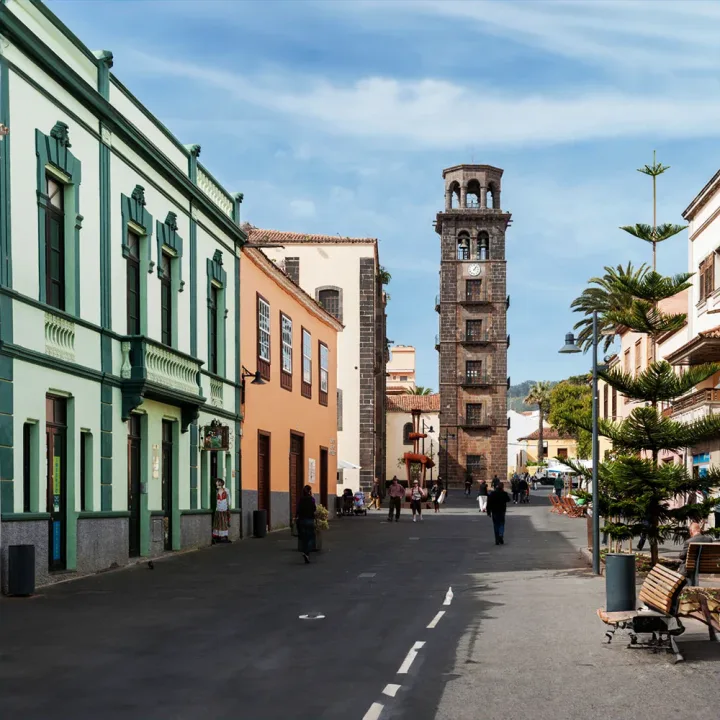 Guided Tours
 North Tenerife Guided Bus Tour
- Santa Cruz, Taganana & La Laguna
- Free hotel pickup
- Departs Mondays and Thursdays
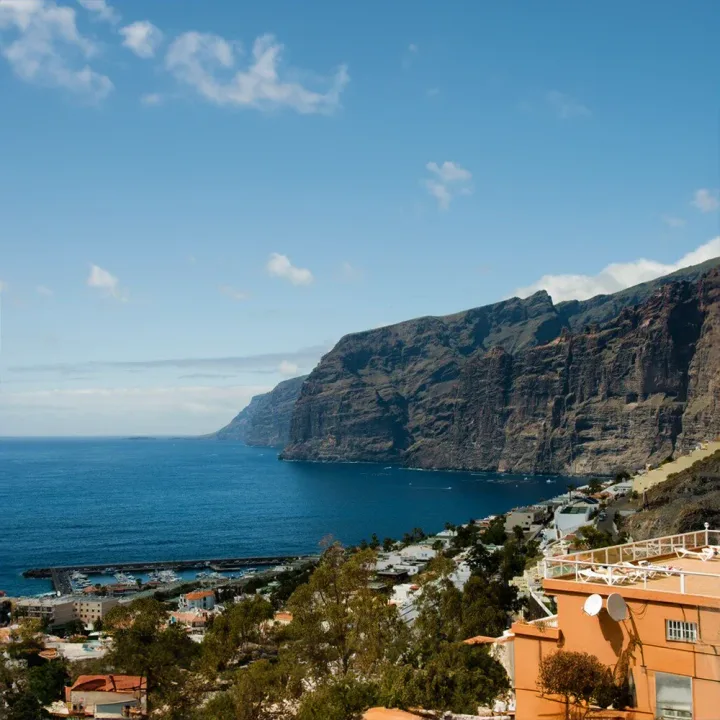 Guided Tours
 Tenerife Island Tour
- Six island stops
- Free hotel pickup
- Departs Tuesdays and Saturdays